A gear-operated butterfly valve may be the right choice for infrequent manual isolation, but it is not automatically suitable for throttling, automatic control, or every hydronic loop. By checking the service, sizing data, pressure limits, materials, connection details, and operator access, you can specify the valve type and gearbox without relying on pipe diameter alone.
Key takeaways
- Use gear operation for infrequent manual isolation when direct hand force is impractical.
- Size from design flow, pressure drop, line pressure, and valve authority.
- Match PN 16 rating, body, disc, seat, and shaft materials to the water.
- Specify gearbox orientation, actuator interface, clearance, and maintenance access.
Choose the valve by duty: isolation, throttling, or automatic control
Use a gear-operated butterfly valve for manual isolation in chilled-water, hot-water, condenser-water, and heating loops when operation is infrequent or direct hand force is impractical.
Resilient-seated butterfly valves are primarily isolation valves for ordinary HVAC water service; the gearbox adds mechanical advantage and holds a manual position, but it does not create automatic flow or temperature control.
| Valve option | What it provides | When it applies |
|---|---|---|
| Hand-lever butterfly valve | Fast quarter-turn operation without multiple gearbox turns | Smaller valves, clear access, and frequent manual operation |
| Gear-operated butterfly valve | Higher mechanical advantage and position holding | Large valves, limited access, or infrequent isolation |
| Motorized butterfly valve | Continuous response to a control signal | Building-management-system control of flow, temperature, or pressure |
A hand lever becomes difficult as size, differential pressure, or access demands increase. A gear operated hvac valve becomes too slow for frequent adjustment unless you accept its operating time and mechanical backlash.
For throttling or automatic control, specify a compatible actuator, confirmed seating and unseating torque, adequate travel resolution, and manufacturer flow-characteristic data. A gearbox alone cannot follow a BMS signal.
Condenser-water service needs extra scrutiny. Suspended solids, biological growth, corrosion products, and oxygenated water can increase operating torque and damage the disc, stem, or seat, so select materials and operator capacity for actual water-treatment and maintenance conditions.
Size the butterfly valve from flow and pressure-drop data
Do not match the valve to nominal pipe diameter alone: base HVAC butterfly valve selection on flow, pressure drop, shutoff differential, temperature, glycol concentration, and pressure class.
1. Record the design flow and allowable valve pressure drop. Use the manufacturer’s Cv or Kv equation to select nominal diameter, then check velocity against the project limit. Request Cv or Kv values across the intended opening range, not only at fully open.
Valve authority affects controllability: an oversized valve has little useful travel at low load, so a small disc movement causes a large flow change.
2. Check the differential pressure at shutoff, pressure class, temperature range, seat material, and required leakage or shutoff level. A valve that handles operating pressure can still fail its permitted closing differential pressure, especially at elevated temperature or in dead-end service.
3. Confirm the body and connection: wafer or lug, pipe connection type, face-to-face dimension, flange standard, bolt arrangement, and internal bore. A wafer valve is clamped between flanges and is generally unsuitable for unsupported dead-end service. A lug valve has tapped lugs, but you still need the manufacturer’s dead-end approval and pressure rating.
4. Before installation, verify flange alignment, flange thickness, gasket position, bolt spacing, and disc clearance. Pipe misalignment, gasket intrusion, or an undersized bore can make the disc strike the pipe or gasket before full opening.
That checklist separates a suitable valve from one that merely fits the line. It also prevents poor control performance in butterfly valves for HVAC applications.
Read PN 16 correctly and match materials to the water
PN 16 is a nominal pressure class, not a promise that the valve can handle 16 bar in every condition. It is separate from normal operating pressure, hydrostatic test pressure, the connected flange rating, and permitted shutoff differential pressure. A valve can pass a test while carrying a lower working or dead-end limit.
Before approving a gear-operated HVAC valve, check the data sheet at the actual fluid temperature, dead-end condition, and seat material. Use the weakest rated component in the piping assembly as the system limit.
- Match the body, disc, stem, and liner to treated chilled water, hot water, glycol concentration, biocides, oils, and hydrocarbons.
- For oxygenated condenser water, verify resistance to suspended solids, biological contamination, and corrosion products; these conditions raise torque and damage seats, discs, and stems.
- Treat EPDM as a starting point for ordinary closed-loop hydronic water, not proof of compatibility with every additive or temperature.
- Record the valve’s working pressure, test pressure, flange rating, and shutoff differential separately.
Seat choice changes the duty:
| Option | Best fit | Trade-off |
|---|---|---|
| Resilient seat | Normal HVAC water and tight isolation | Temperature, chemical, erosion, and pressure limits |
| Metal seat, high-performance or triple-offset | Higher temperature, pressure, fire, erosion, or chemical demand | Different leakage performance and higher operating torque |
That distinction is central to HVAC butterfly valve selection. A resilient seat usually wins on cost and maintenance; metal seating becomes worthwhile when the water or duty exceeds elastomer limits.
Specify the gearbox, actuator interface, and access around the valve
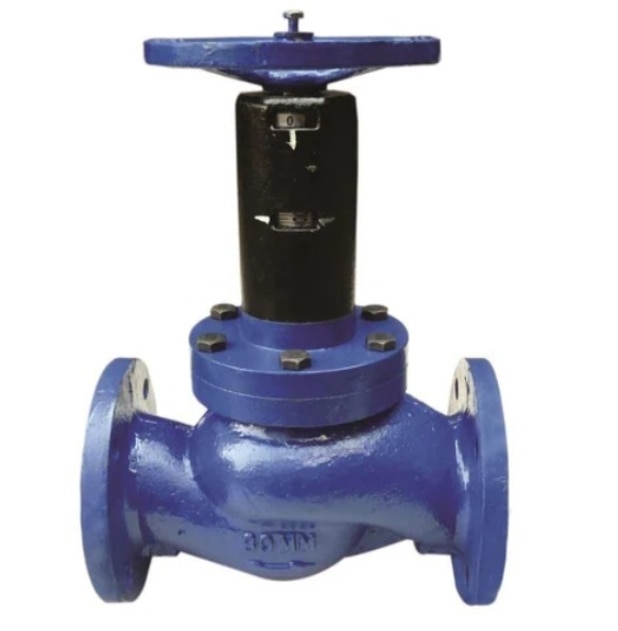
A gear-operated HVAC valve remains usable only when its gearbox and stem assembly are rated for the actual seating and unseating torque at the stated differential pressure. Specify allowance for seat friction, disc position, temperature, corrosion, and solids; nominal valve size alone cannot size the operator.
| Operator | Handwheel effort and speed | Suitable use | Limitation |
|---|---|---|---|
| Hand lever | Low turn count and rapid quarter-turn movement | Smaller butterfly valves for frequent manual operation | Effort becomes impractical on larger valves |
| Gearbox | Higher mechanical advantage but more handwheel turns | Large valves and infrequent isolation | Too slow for frequent adjustment |
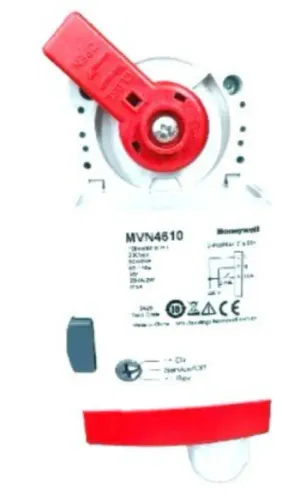
| Motorized actuator | Powered travel with controllable positioning | Automatic response to a building-management-system signal | Requires verified torque, travel, and modulating performance |
Check the gearbox ratio against operation frequency. A slow gearbox suits occasional isolation but frustrates balancing or repeated adjustment. Position indication and a locking arrangement must remain visible and usable.
ISO 5211 standardizes some quarter-turn actuator and gearbox mounting dimensions; it does not confirm pressure rating, torque capacity, seat material, flow characteristic, or HVAC suitability. An ISO 5211 interface still needs a valve-specific torque, travel, shutoff, and environmental check.
For butterfly valves for HVAC, coordinate installation details before insulation:
- Leave clearance to remove the gearbox, actuator, stem extension, and limit switches.
- Keep the operator outside insulation where inspection is required.
- Specify a chainwheel or extension for valves above ceilings or beyond reach.
- Reserve removable maintenance space in plant rooms.
Condenser-water solids, biological growth, and corrosion products can increase torque. Verify backlash and travel resolution before adding a motorized actuator to a gear operated HVAC valve.
Turn the selection into a purchase and installation specification
Write the schedule as a purchase control, not a product name. For HVAC valves, a gear-operated butterfly valve is specified in this sequence:
- Service fluid and loop; design flow; temperature; glycol percentage; operating and test pressures; shutoff differential pressure.
- Pipe size and flange standard; wafer or lug body; face-to-face dimension; body, disc, stem, and seat materials; required Cv or Kv at the working opening.
- Leakage or shutoff requirement; gearbox seating and unseating torque, number of turns, position indication, locking method, actuator interface, insulation clearance, access space, and any dead-end or fire-service requirement.
| Body choice | Installation consequence | Check before ordering |
|---|---|---|
| Wafer | Clamped between flanges; usually unsuitable for unsupported dead-end service | Confirm alignment, gasket intrusion, bolt arrangement, disc clearance, and dead-end rating |
| Lug | Tapped lugs permit more flexible bolting and isolation | Confirm lug pressure rating and dead-end approval |
| Fire-service | Requires listed or approved indicating construction and supervisory-switch provisions | Never substitute an ordinary HVAC butterfly valve where the adopted fire code requires listed fire-protection equipment |
Require Cv or Kv data across the intended opening range; a nominal line size can produce poor control. ISO 5211 confirms an actuator mounting pattern, not torque, pressure rating, seat compatibility, or modulating performance.
For an hvac butterfly valve selection, compare data sheets, actuator compatibility, connection dimensions, and service conditions with Shiv Shakti Hardware Store for a Delhi NCR project. The specification—not the label or nominal pipe size—must control the purchase.
Related product
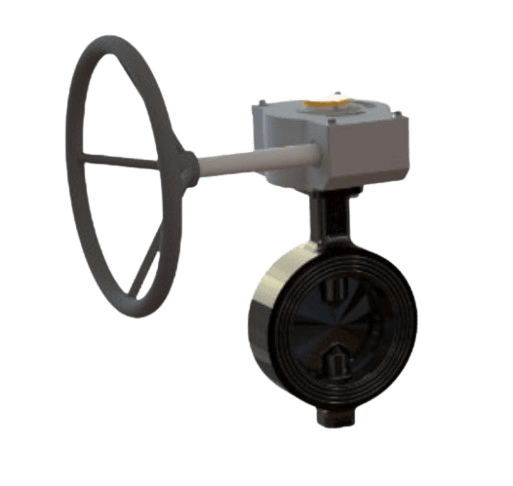 | Butterfly Valve ₹6862 A Honeywell Impact butterfly valve PN 16 is typically used for regulating the flow of water in heating and cooling systems, particularly in HVAC... View product → |
Frequently asked questions
When should you use a gear-operated butterfly valve in an HVAC system?
Use one for manual isolation in chilled-water, hot-water, condenser-water, and heating loops when operation is infrequent or direct hand force is impractical. Choose a control valve instead when the valve must modulate automatically.
How do you size a butterfly valve for HVAC water service?
Start with design flow and allowable pressure drop, then check the selected valve’s flow coefficient, pressure rating, velocity, and shutoff differential pressure. Do not size only from the connecting pipe diameter.
What does PN 16 mean on an HVAC butterfly valve?
PN 16 identifies a nominal pressure class, not a universal 16-bar operating limit at every temperature. Confirm the manufacturer’s pressure-temperature table and match the flange pattern, face-to-face dimension, and line materials.
What should you specify for the gearbox and valve installation?
Specify manual or automatic operation, gearbox output and travel limits, actuator mounting interface, fail position if actuated, handwheel access, stem orientation, insulation clearance, and space for inspection or replacement.
Keywords