A rotary actuator does more than turn a valve: its torque, travel, power supply and control signal determine whether a hydronic system regulates flow accurately or stalls at the worst moment. By the end, you will be able to match an MVN assembly to a two-way HVAC valve, check its electrical and fail-position requirements, and prepare a commissioning checklist before ordering.
Key takeaways
- Match the MVN actuator’s torque and rotation to the valve body before installation.
- Confirm voltage, control signal, stroke direction and fail position on the datasheet.
- Use overload protection and feedback checks during commissioning, not as substitutes for correct sizing.
- Ask a Noida supplier for compatibility, wiring and commissioning documents before ordering.
How MVN control changes chilled-water and hot-water flow
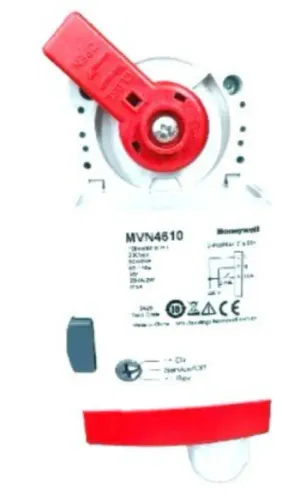
An MVN 4610 actuator rotates the shaft of a compatible two-way valve to regulate chilled-water or hot-water flow. Instead of leaving the valve fully open or fully closed, it positions the valve between those limits as the controller responds to room, supply-air or water-temperature readings.
The result is steadier coil output, less temperature overshoot and less hunting around the setpoint when valve sizing, sensor placement and commissioning are correct.
| Control mode | Controller signal | Flow behaviour | Typical use |
|---|---|---|---|
| On-off | Relay or two-position command | Valve drives fully open or fully closed | Simple demand control |
| Modulating | Proportional voltage, such as 0–10 V or 2–10 V, when specified by the code | Valve holds intermediate positions | Stable temperature control |
| Floating or three-point | Open, close and common commands | Valve moves in either direction until stopped | Controllers without proportional output |
The MVN actuator benefits disappear if the selected code does not match the controller output. Confirm the exact signal before ordering; not every MVN accepts 0–10 V, 2–10 V, floating control or two-position control.
A Honeywell dealer in Noida can also check whether the valve has a rotary shaft, correct coupling, required torque and matching rotation angle. Analogue position feedback, where fitted, reports travel to a controller; it does not make the actuator a BACnet or Modbus device.
Surface exposure, condensation and access for manual override also affect the installation choice.
How to match the actuator to the valve body
A two-way valve body fits an MVN actuator only when its shaft, coupling, rotation, torque and mounting interface match the actuator. A two-way flow path alone proves nothing; an incompatible pairing can cause leakage, shaft damage or incomplete closure.
1. Confirm that the valve has a rotary stem, not a linear stem. Match the stem shape, diameter, adapter and coupling supplied for that Honeywell valve family. Do not fit an MVN actuator directly to a butterfly-valve stem unless the specified interface and torque requirements agree.
2. Compare the valve’s required rotation with the actuator’s rotation limits. The shaft must reach both the fully open and fully closed positions without forcing the actuator against an incorrect stop.
3. Check the actuator torque rating against the valve’s required running and seating torque at the actual differential pressure. A bench test with no water load can pass while the installed valve stalls or fails to shut.
4. Match the valve body’s mounting pattern, bracket, stem height and permitted actuator orientation. An adapter that only appears to fit can leave the coupling partly engaged and allow slipping.
5. Inspect a retrofit valve for a bent or corroded stem, excessive packing friction and leakage through the closed port. Replace the complete assembly when the body needs abnormal force or its interface is obsolete.
For anyone searching actuator MVN Noida or two way valve actuator noida, the proof is the valve-and-actuator combination, not the MVN label alone. After installation, command full travel and verify open and closed positions under expected system pressure.
Which power, signal and fail-position details must be confirmed
A 230 VAC actuator must match the control panel’s supply before you connect any command wire. Check the complete MVN ordering code, because voltage, control method, torque, spring-return status, auxiliary switches and feedback options can produce different part numbers.
- Confirm the panel output: 230 VAC, 24 VAC or 24 VDC. These supplies are not interchangeable.
- Confirm whether the controller sends two-position, floating or modulating control. Do not assume every MVN accepts 0–10 V or 2–10 V.
- Treat the 0–10 V signal as a command, not as actuator power. Provide the separate supply and the manufacturer’s specified common connection.
- Match terminal labels, common wiring and polarity to the wiring diagram. A reversed common or polarity can look like a failed actuator.
- State the required loss-of-power action: drive open, drive closed or stop and remain in position.
- Confirm whether spring return is required, and verify the spring direction against the valve’s intended fail position.
- Ask the honeywell actuator supplier noida to quote the full code, not “MVN” alone.
| Control option | Command and power check | Ordering consequence |
|---|---|---|
| Two-position | Switched supply opens or closes the actuator | Select an on-off code |
| Floating or three-point | Separate open, close and common connections | Select a floating-control code |
| Modulating | 0–10 V or 2–10 V command plus separate actuator power | Confirm signal range, common and feedback |
| Spring-return | Spring drives the specified fail position after power loss | Confirm fail direction and spring torque |
| Non-spring-return | Power loss stops travel; it does not provide a spring-defined position | Do not specify it where fail-open or fail-closed action is required |
What overload protection, feedback and commissioning actually cover
A jam should not be treated as a normal end stop. Overload protection should stop the motor when valve torque exceeds the actuator rating, preventing prolonged stall and possible stem or gear damage. Do not assume it will clear the obstruction; inspect the valve and confirm the specified reset behaviour.
Power loss follows the selected MVN configuration. A spring-return model drives the valve to its specified fail-open or fail-closed position, while a non-spring-return model can remain in its last position. After power returns, verify that the actuator does not unexpectedly reverse, hunt or lose its end-position reference.
A BMS command sets the requested valve position. Feedback, where fitted, reports actual position or provides auxiliary end-switch status; analogue feedback is not BACnet or Modbus communication. A command of 60% is not proof that the valve reached 60%.
Commission the installed valve and actuator together:
- Command closed, then open, and confirm correct rotation, smooth travel and the expected response time.
- Check actual position against the BMS command throughout the stroke.
- Confirm full-open and full-closed indication where those switches are fitted.
- Remove power and record the resulting fail position; restore power and test the restart sequence.
- Repeat the travel test at expected differential pressure, because stiction or inadequate closing force can disappear on an unloaded bench.
- Inspect stem coupling, mounting, manual override access and signs of binding.
- Confirm ambient temperature, humidity, condensation exposure and enclosure protection suit the installation.
A passing actuator bench test does not prove tight shutoff or reliable flow control in the pipe.
What to ask a Noida supplier before buying or retrofitting
A supplier cannot select a reliable MVN assembly from “two-way valve” alone. Send the valve datasheet, existing actuator nameplate, BMS point list, wiring diagram and clear photographs of the valve, coupling and installation space.
If the application involves a fire or smoke damper, say so immediately; an HVAC MVN actuator is not a substitute for listed life-safety equipment.
Give the Honeywell dealer in Noida these site details:
- Valve manufacturer, model, nominal size, pressure class, medium, design temperature and required flow direction.
- Shaft or stem shape, mounting pattern, required rotation angle, available clearance and manual-override access.
- Required actuator torque, fail position during power loss, mounting orientation and any adapter or rotation-stop requirement.
- Supply voltage, control method, signal range, BMS wiring arrangement, auxiliary switches and feedback requirement.
- Plantroom or rooftop conditions: ambient temperature range, humidity, condensation, washdown exposure, vibration and enclosure protection.
- Existing code, serial plate and commissioning records for a retrofit.
Use this ordering check before accepting a quotation:
| Detail to confirm | What the code or document must show | Why it matters |
|---|---|---|
| Voltage | Exact supply, such as 230 VAC or the specified low-voltage supply | Prevents unsafe wiring |
| Control input | On-off, floating or modulating signal and its range | Prevents a BMS mismatch |
| Options | Torque, spring return, auxiliary switches and feedback | Changes operation and price |
| Valve interface | Compatible valve family, coupling, rotation and adapter | Prevents leakage or shaft damage |
Shiv Shakti Hardware Store can use these details to distinguish a complete, compatible MVN assembly from a generic “actuator MVN Noida” quotation.
Related product
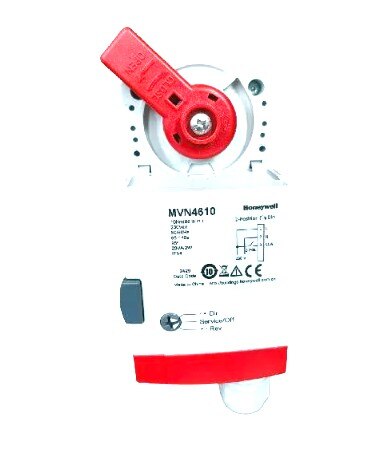 | Two way valve actuator 230vac ₹4956 The MVN Series ball valve actuators are designed for easy installation with pre-mounted brackets, compatible with VBA16P and VBA16F series valves,... View product → |
Frequently asked questions
How does an MVN actuator control chilled-water and hot-water flow?
The actuator rotates a compatible two-way valve shaft to position the valve between closed and open limits. A controller adjusts that position from room, supply-air or water-temperature readings.
How do you match an MVN actuator to a valve body?
Confirm the valve series, body size, shaft interface, rotation angle and required closing torque. The actuator and valve must be mechanically compatible before installation.
Which MVN actuator power, signal and fail-position details must you confirm?
Check the supply voltage, control signal type, wiring terminals, rotation direction and the required position during power loss. Confirm each item against the actuator and controller documentation.
What do overload protection and feedback cover during commissioning?
Overload protection helps limit actuator damage when resistance exceeds its rated capability. Feedback confirms position to the controller, but commissioning still requires checking stroke, direction, valve movement and control response.
What should you ask a Noida supplier before buying or retrofitting an MVN actuator?
Ask for valve-actuator compatibility confirmation, torque and voltage data, wiring diagrams, control-signal details, fail-position information, feedback options and commissioning support.
Keywords